
Territorialidad en los reales de minas en el norte del Cauca, 1851-1930

Palabras clave:
espacialidad, libre epistémico., reales de minas, negro libre, libre epistémicoBarra lateral del artículo
Contenido principal del artículo
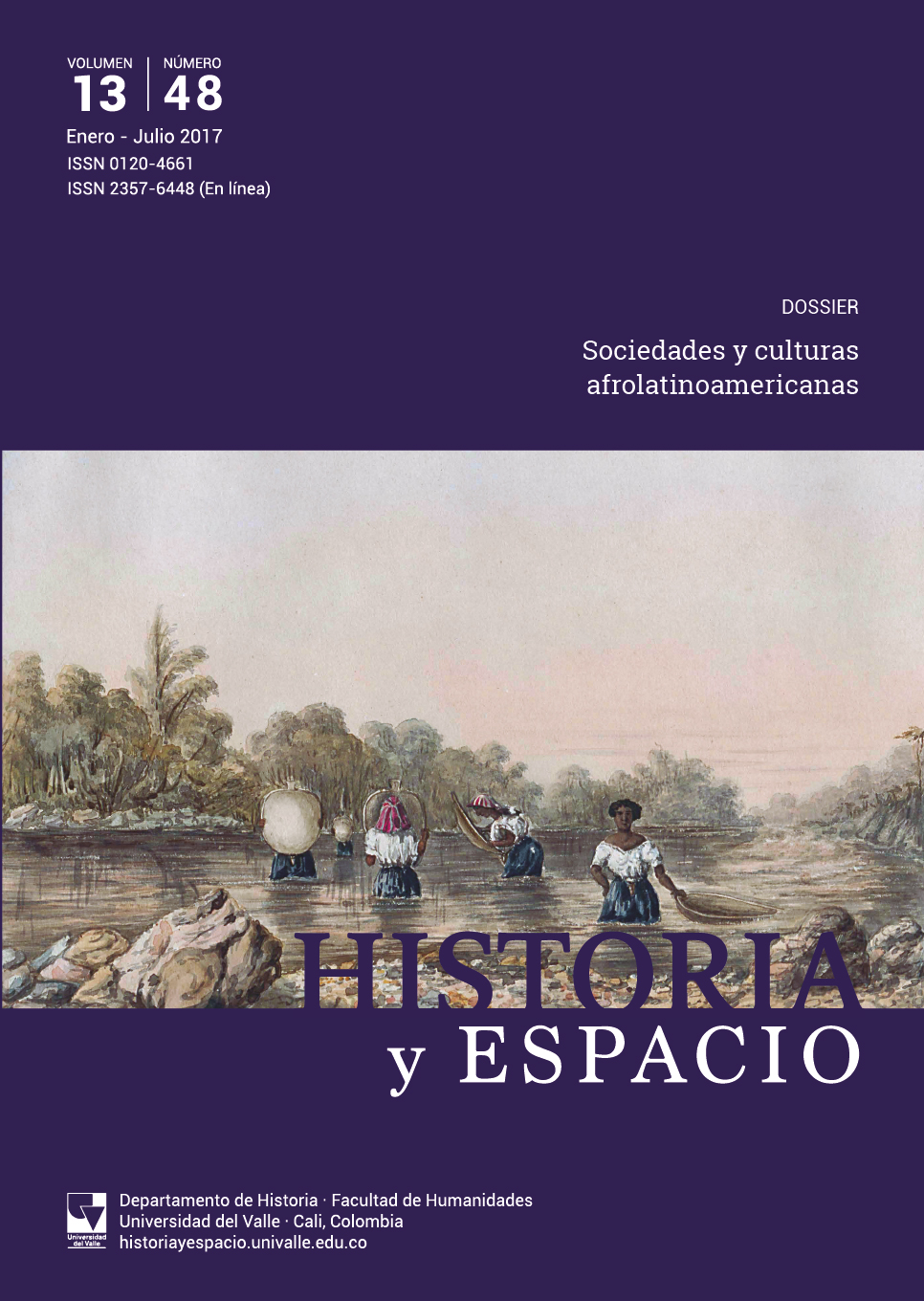
Este artículo se propone evidenciar las condiciones históricas, sociales, políticas y simbólicas propias de los libres entre 1851 y 1930 en las espacialidades de Dominguillo, Quinamayó, Santa María, San Antonio, Arrobleda y Gelima localizadas en el norte del Cauca (Colombia). Condiciones que les permitieron a estas poblaciones reinventar el espacio social como un proceso de re-existencia, de apropiación social y territorial que venían construyendo desde el siglo XVIII. Muestra, a partir de los hallazgos que resultaron de la implementación de una metodología genealógica, las condiciones socio-históricas que redefinieron a los poblados afros del norte del Cauca, entre 1851-1930 y que permitieron la reinvención de la espacialidad como un proceso de re-existencia, de apropiación social, y territorial. Presenta una reconstrucción de la memoria histórica del negro libre cuyos resultados se evidencian en la conformación de una historicidad del libre epistémico (libre esclavizado, libre afrodiaspórico, libre propietario y no propietario y libre campesino), que compitió la espacialidad con el propietario de las minas y de la hacienda; y en lo cual un hallazgo novedoso fue la estrategia de localización que muestra cómo los negros libres redistribuyeron entre sus congéneres la propiedad territorial para poder re-existir y no desaparecer como cultura y pervivir como movimiento social.
Manuscritas
Archivo Central del Cauca (ACC), Popayán - Colombia. Fondo Colonia, signaturas: 12151, 1660, 2443, 2955, 11367, 11383, 11246, 7773, 8041, 8244, 4694, 11511, 4328, 2202, 1107, 5353, 6152, 6992, 11735
Archivo General de la Nación (AGN), Bogotá - Colombia, Secciones: Poblaciones del Cauca, Tomo II, f. 652, 709r, a 720r, Fondo Colonia.
Archivo Histórico Nacional de Ecuador (AHNE), Quito - Ecuador, Fondo esclavos: Caja N° 15, Exp.7, Caja 21, Exp. 10.
Entrevistas
Aguilar, James en conversación con el autor, Santander de Quilichao - Cauca, 08 de julio de 2015.
Carabalí, Juan Bautista en conversación con el autor vereda San Antonio, Santander de Quilichao - Cauca, 16 de mayo de 2015.
González, Edgar en conversación con el autor, corregimiento de La Toma, Suárez - Cauca, 30 de julio de 2015.
Abonía, Bernabé en conversación con el autor, vereda Mazamorrero, Santander de Quilichao - Cauca, 20 de julio de 2015.
Fuentes secundarias
Almario, Oscar. La configuración moderna del valle del Cauca, Colombia 1850-1940. Espacio, poblamiento, poder y cultura. Cali, Colombia: Cecan Editores, 2013.
Almario, Oscar. “De los eventos aislados a la trama social”. En las fuentes, sujetos e interacciones en la etnogénesis negra del Pacífico sur colombiano durante el siglo XVIII. Editado por Oscar Almario, 159-222. Medellín, Colombia: Editorial Universidad Nacional de Colombia Sede Medellín, 2014.
Angola, Betty y Aura Borrero. “Los negros y el acceso a la propiedad de la tierra: el caso de Santa Bárbara de Dominguillo. 1851-1930”. Tesis Pregrado en Licenciatura en Ciencias Sociales, Universidad del Valle, 2000.
Charria, Ernesto. Santander de Quilichao, fundación, Colonia, Independencia y República. 1543-1943. Santander de Quilichao, Colombia: s. e. 1943.
Escobar, Arturo. Territorios de diferencia: lugar, movimientos, vida, redes. Popayán, Colombia: Envión Editores, 2010.
Navarrete, María Cristina. Génesis y desarrollo de la esclavitud en Colombia. Siglos XVI y XVII. Cali, Colombia: Universidad del Valle, Programa Editorial, 2005.
Romero, Mario Diego. Poblamiento y sociedad en el Pacífico colombiano siglos XVI al XVIII. Cali, Colombia: Editorial Universidad del Valle, 1995.
Romero, Mario Diego. Territorialidad y familia en el sur del valle geográfico del río Cauca. Cali, Colombia: en proceso de publicación, 2012.
Sandoval, Neftalí. Quilichao: su historia, su geografía y biografías de sus hombres representativos. Santander de Quilichao, Colombia: inédito, 1963.